
Fairground Feedback: Grounded Conversations for Embodied Transformation
Part 1: Art of Voice & Healing-Centered Leadership
Written by
Melissa Andrada, MSc. (mel - they/them)
CEO & Cofounder
Sol Garcia Jones, MA (they/them)
Equity Facilitator & Science Fiction Writer
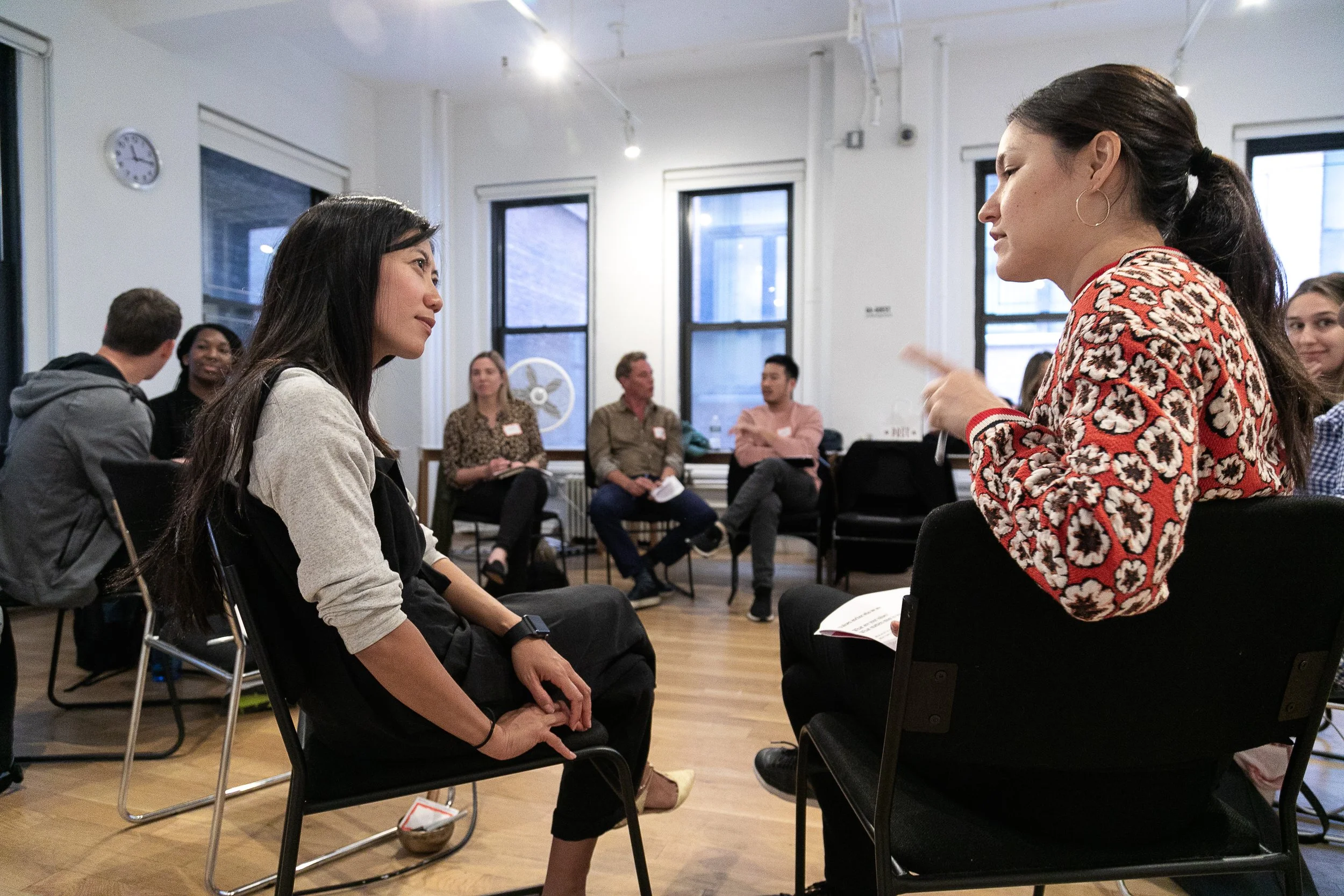
PRACTICE/ BREATHING
-
Thank you for being here. We typically think of reading as an intellectual activity. If you’re reading this, we invite you to begin with a practice of embodied leadership: intentional breathing.
Beginning with three deep breaths from the diaphragm. Slowly inhaling through your nose, exhaling out through your mouth.
Making your exhalations deeper than your inhalation, activating the parasympathetic nervous system, responsible for sleep and rest.
Notice how you feel in your body now?
What do you need before reading?
You might be wondering:
Why does feedback feel so challenging to give and receive?
Why do I feel so upset before or after feedback conversations?
Why do feedback trainings give me the right words but still fail?
Can I give feedback that doesn’t make me feel like a robot or AI?
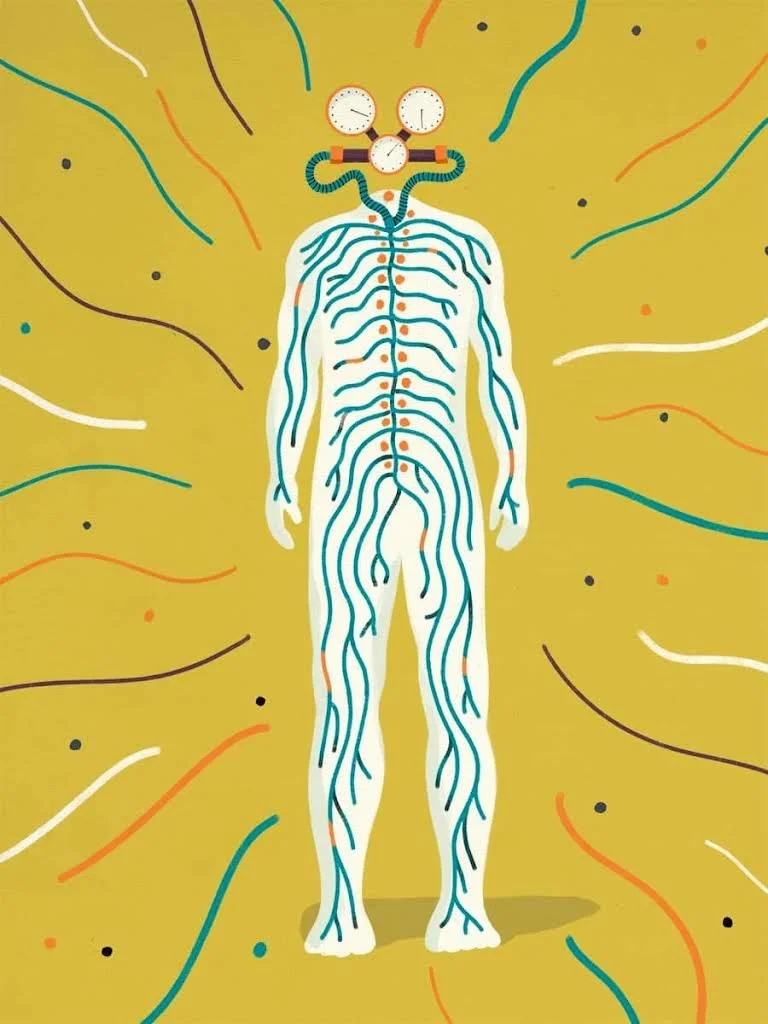
Note. This image was created by Nike to demonstrate how the nervous system works
How do I give feedback that meets my and our goals while also showing compassion and care to those around me?
Giving feedback is one of those universal challenges in the workplace – indeed, in life. No matter your role or level in your career, giving feedback makes the work you do, as well as that of your team, better. And the more skillfully the feedback is given, the more people and organizations develop. So given that delivering feedback is such a necessary part of work, why then do so many people and organizations struggle to do it? We propose a new theory of change for feedback and embodied transformation rooted in the latest research in somatics, the nervous system and clinical psychology.
Much of feedback training and thought is rooted in giving people a script and formula to have it be heard clearly. Our team has spent years teaching feedback using many well-known and lauded frameworks and yet it felt like there was another component that needed naming: an understanding of the nervous system.
This is because such frameworks too often rely solely on the assumption that people have full-time access to their prefrontal cortex, responsible for rational thinking and executive functioning. The problem is our bodies all hold trauma, some which may be conscious or conscious. This invites the question: What is trauma?
Our Definition of Trauma
Building on the work of Staici Haines, Cara Page and Erica Woodland, Hala Khouri, Drs. Carrie Clark and Catherine C. Classen, this is our definition:
Trauma is an experience or set of experiences - within and outside of work - that disrupts our safety, belonging and dignity, leaving us feeling helpless, hopeless and out of control at work. This can be further impacted by unequal access to resources due to one’s social location, including, but not limited to adverse adult and childhood experiences, race, gender, sexual identity, ability, class, religion, and other forms of oppression, while simultaneously having little-to-no capacity internally or externally to cope, due to the impact of said trauma.
Each person may feel fear, anxiety, stress and tension. Their nervous system is more likely to enter into a freeze, flight or fight response, disrupting strategic thinking, collaboration and productivity at work. This disruption includes feedback conversations.
-
The impact of trauma within the workplace can result from:
a) experiences that occur at work that impact our capacity to feel safe and perform to the best of our abilities, including but not limited to:
Microaggressions, harassment, discrimination, bullying, public humiliation, gaslighting or psychological manipulation
Unrealistic expectations and overwork
b) Experiences that occurred outside work that impact our capacity to feel safe and perform to the best of our abilities.
Natural disasters, racism, sexual violence, death and loss, sexism, illness, accidents, ableism, Islamophobia, antisemitism, xenophobia, transphobia, homophobia, ageism, adverse child experiences and more are forms of trauma that impact our safety at work.
Favoritism, gossiping, withholding information, and unfair work practices connected to promotions, firing, and career development.
Sudden job losses, layoffs, furloughs, and organizational restructuring.
Requests for support or resources, not compassionately met by managers and colleagues.
Environmental and safety hazards, accidents and workplace injuries
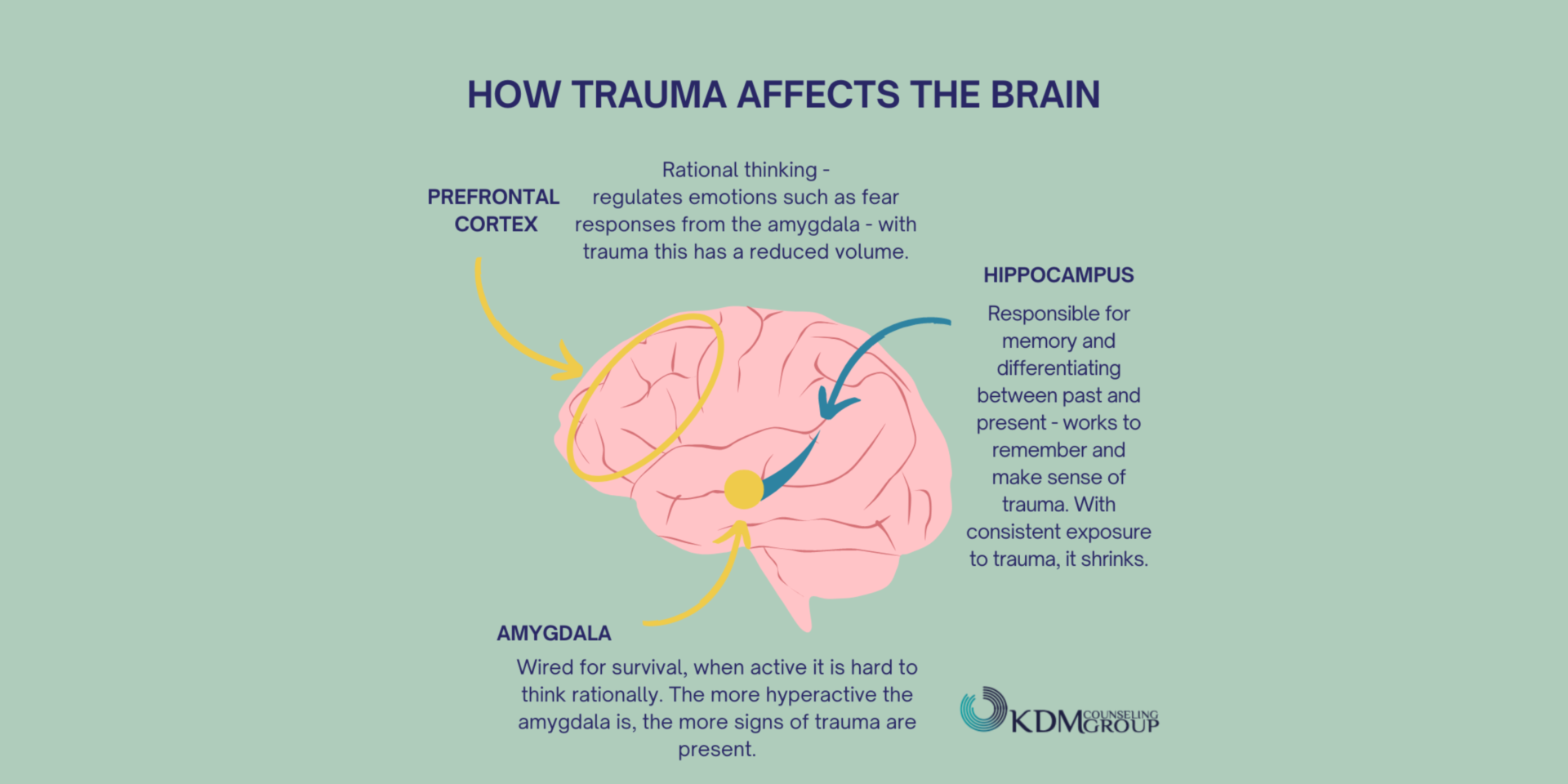
Note. This image was created by KDM Counselling Group to demonstrate how trauma impacts the brain
Feedback and difficult conversations often activate what’s called a ‘trauma response’ because the autonomic nervous system feels under ‘threat’ or ‘unsafe.’ We all have trauma in our lives, regardless of seniority, identity, or life experience. At the end of day, even with our fancy job titles, we are animals. When a trauma response happens, our amygdala and our flight-fight-freeze stress response may get activated. Whilst we may intellectually know we are ‘safe’, our hippocampus may shrink and the autonomic nervous system has trouble differentiating between past and present, colleague and constructive criticism versus foe and physical attack.
Thus, before we get to the exact framework and structure to use, we need to investigate the circumstances under which we can feel grounded and under which our teams can reach a sense of safety, even in the most difficult conversations. This article will dig into the thinking needed to create such a space.
Our methodology intentionally brings a holistic lens that brings together the professional and the personal -- and everything in between. Feedback is both science and art. A creative embodied practice of agility and adaptability, that cannot be mimicked by AI.
We hope to evoke collective cultural change that begins with the body.
CONTENT
1 - Start with Why: Our Stories of Feedback and Healing
2 - Introducing: Fairground Feedback Principles for Transformation
3 - Fairground Feedback Principle: Grounded Clarity
4 - Fairground Feedback Principle: Emotional Attunement
5 - Fairground Feedback Principle: Holistic Fairness
6 - Fairground Feedback Principle: Empowered Action
7 - Conclusion: Feedback is a Lifelong Embodied Practice
Mel’s Story: Imposter Syndrome to Inner Leader
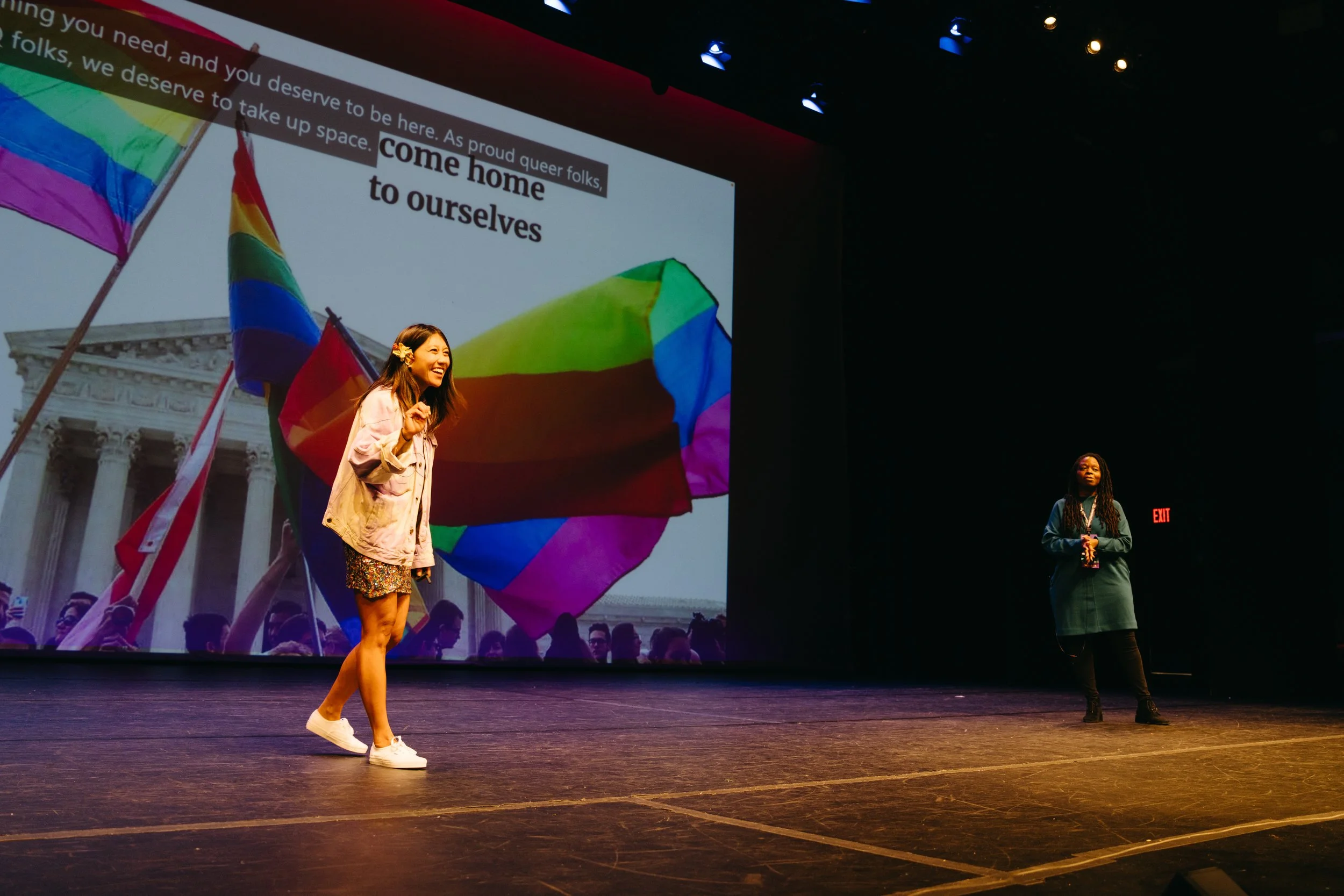
Interactive Keynote: Stepping Into Your Power As A Public Speaker to 500+ queer leaders
Out in Tech’s Annual Leadership Institute
Brooklyn, New York
When I began my career as a digital strategic consultant in New York City in 2009, I felt a deep sense of what folks might call the “imposter syndrome.” Well-intentioned white cisgender male colleagues would often encourage me to “speak up more and be more confident,” yet their feedback often lacked both cultural and emotional attunement and clear specific action.
As one of the few ‘only’s’ across multiple categories, I felt inferior in comparison to my colleagues, most of whom were white, straight, cisgender, able-bodied, neuro-mainstream classically good-looking Ivy League graduates from middle and upper class backgrounds. I often felt a deep sense of othered loneliness as a queer multi-gender loving and gender expansive Filipine American born in Nigeria who came to the States as an immigrant and grew up low-income with parents who worked as nannies and cleaners. My incapacity to speak up at work was a trauma ‘freeze’ response resulting from systemic oppression, rather than a personality trait.
While the intentions of my colleagues were well-meaning, I felt an even deeper sense of fear to perform and speak up. I longed for a mentor and manager with the emotional acumen and critical allyship skills to compassionately share feedback based around my needs and lived experience.
Feedback, at its best, evokes a profound sense of possibility and potential, propelling us into our most powerful expression of leadership and performance. A Feedforward.
Eventually, I was surrounded by a community of co-leaders who resourced me with the feedback and coaching to do what I do now -- a speaker for speakers, committed to nourishing safety, healing and more importantly, joy at work and in life.
Sol’s Story: Building a New Relationship with Conflict and Feedback

I grew up in a family that had a poor relationship with conflict and feedback. While I knew intense feelings were under the surface – sometimes blowing up via snappy comments from my Mom – I did not experience a space where difficult conversations were had with finesse and groundedness, nor ever experienced a real sense of closure in these spaces.
Thus, when I entered the workplace, even the most basic feedback felt like an attack. I would apologize profusely, assuming that whatever I did was catastrophic and required immediate attention. It didn’t help that I started with a series of young managers in non profit education work who felt an intense pressure themselves to “get everything right,” often passing on unrealistic expectations of work hours and work product.
It wasn’t until I met who became my first real coach and mentor that I experienced kind, grounded, actionable feedback. This manager gave me some of the toughest feedback of my career – even putting me on a performance improvement plan – but with a firm belief that this information and plan would catapult me to success. Her belief and adjusting coaching made a profound impact on me. I grew immensely, becoming her ‘right hand’ and garnering multiple promotions. More importantly however, I found a belief in myself and in my ability to grow.
1. INTRODUCTION
Fairground Feedback
for Embodied Transformation
Principles (CAFA)
Grounded
Clarity
The ability to provide feedback rooted in shared expectations and behavioral observations, rather than personal opinions, judgements or vague subjective statements.
Emotional
Attunement
The ability to cultivate a culture where we can be vulnerable and share our communication needs, and develop the embodied presence and awareness to recognize what a person is feeling and adjust your communication delivery accordingly.
Holistic
Fairness
Ability to understand the power dynamics, social-cultural experiences and personal challenges that may be impacting a person’s presence and capacity in order to support a more skillful feedback conversation.
Empowered
Action
Ability to offer grounded requests and co-create solutions alongside support and outside resources to action the feedback and support growth.
Fairground Feedback Principle
Grounded
Clarity
The ability to provide feedback rooted in shared expectations and behavioral observations, rather than personal opinions, judgements or vague subjective statements.
Shared expectations
Are the expectations and outcomes of the [role / project / relationship ] clear, specific and realistic to this individual?
Does this person have the guidance and resources to transform their behavior and succeed?
Is there consistent accountability and check-ins in place to understand progress?
We may provide critical feedback without providing crystal clarity on the expectations or have unrealistic expectations that the person is neither trained nor resourced to meet. It can be easy to forget that people cannot read our minds nor work exactly in the same way nor at the same speed. We can amend this by taking the time to get to know our people and co-creating a shared collective vision of expectations rooted in our individual stories, strengths and stretch zones.
-
Centering in grounded clarity is necessary in living with others. With roommates and partners, understanding and visiting shared expectations means that the living situation works for the group: whether that is level of cleanliness, time for quiet or noise, or community vs. solo time. When these expectations aren’t discussed and no set check-ins happen, it is a recipe for resentment. Sol has lived in spaces with little to no discussion of expectations all the way to a house charter with roles and responsibilities on the kitchen fridge. Having this clarity meant that there was ground to stand on when the house felt dysfunctional and rooted conversations in something clear and defined. Without grounded clarity, the living space can default to personal preference, or allow frustration to brew and even cause the living situation to become untenable.
Behavioral Observations
What addressable behaviors can you observe? What is the opportunity for growth?
Based on the shared expectations, what is the impact of behaviors on [the project, the team, the relationship, etc.]
It can be tempting to default to judgements, such as, “They’re disorganized”, “They just don’t get it”, “They need to work on their confidence” or “They are never going to change.” These statements do not provide feedback that the individual can immediately and proactively action.
Clinical psychology can offer a framing in this regard. Mel’s work has helped them develop deep acumen around behavior-based observations to inform the objective (objectivity being the aspiration) criteria by which we diagnose mental health disorders and provide treatment. Striving to achieve this level of rigor can be useful for how we approach workplace performance and feedback.
Fairground Feedback Principle
Emotional
Attunement
The ability to cultivate a culture where we can be vulnerable and share our communication needs, and develop the embodied presence and awareness to recognize what a person is feeling and adjust your communication delivery accordingly.

Feedback Prompts inspired by our Communication Empathy Guide, a tool we use clients to have more skillful conversations.
What are we doing to cultivate psychological and emotional safety in our 1:1 professional and personal conversations and relationships?
What are the communication needs of this individual?
What life or health circumstances might be impacting their emotional capacity to give or receive feedback?
What might be the most impactful way to share this feedback?
Confidential Environment
in a private room or office
walking outside in nature
at home over video
Tone of Voice & Pacing
speedy & staccato
spacious, silence & pauses
directive & instructive (“tell me exactly what to do”)
gentle, open & collaborative (“how we might we approach this?”)
Embodied Language
constant direct eye contact, intermittent soft eye contact
side by side, directly facing each other
sitting, standing, walking
Words & Verbal Language
an ice breaker question
“How are you?”
“How’s it going?”
“How are you feeling?
a statement of belief or support
“We want you to succeed.”
“I care about you and our relationship.”
“I want you to help you get your promotion.”
open-ended self reflective question
“How do you think the [project / meeting / conversation ] went?
“What did you learn?”
“What would you have done differently?”
What might be the personal and cultural differences in communication?
internal processing (more time to think) versus external processing (think aloud)
more ‘direct’ versus more ‘discreet’
differences in relationship to humor and playful speech (appropriate for some, not appropriate for others)
According to Albert Mehrabian’s research at UCLA in the 1960s, 55% of communication is nonverbal language. While we may be using words to show calm and compassion, if we are anxious, frustrated, or overwhelmed, this will show during feedback. As such, grounding before a difficult conversation, such as with deep breathing, can create space for this emotional attunement. Polyvagal theory shows us that most of what is happening in our nervous system happens beneath our conscious awareness, so engaging in mindful activities before giving feedback will create the spaciousness needed for emotional attunement.

Returning back to the prefrontal cortex
Image made by Embark Recovery to explain impact of trauma on brain
PRACTICE/ Breathwork
-
Slowing down the breath, especially longer exhales activates the parasympathetic nervous system before a feedback conversation
Inhale deeply for count of 4
Hold the breath for count of 6
Exhale deeply for count of 8
Repeat 3-4x
Notice: How do you feel?
Fairground Feedback Principle
Holistic
Fairness
Ability to understand the power dynamics, social-cultural experiences and personal challenges that may be impacting a person’s presence and capacity in order to support a more equitable feedback conversation.
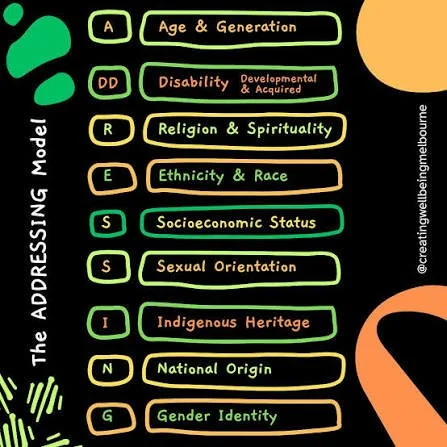
Created by Creative Therapist Mx Rae Sabine
We encourage you to use the widely used ADDRESSING mental health framework created by Pamela Hays to facilitate an individually attuned understanding of yourself and each person on your work team. Many clinicians of psychology in the States use this tool to develop more self awareness and compassionate understanding of their clients.
Cultural Profile
Understand the areas where you or your teammates may carry more or less power -- and how this may impact your perception and expectations of work performance
Who carries historically less or more power? What is the impact on work and life?
For example, the elderly and children may carry less social power than emerging and middle-aged adults. This may impact their capacity to be taken seriously at work.
Age & Generational Influences
Developmental Disability
Disability Acquired Later in Life
Religion & Spirituality Orientation
Ethnic & Racial Identity
Socioeconomic Status
Sexual Orientation
Indigenous Heritage
National Origin
Gender
What ADDRESSING socio-factors might most impact and bias your perception of another person’s behavior and performance across key scenarios?
Presentations & Public Speaking
For example, women are 1.4x (study did not cover nonbinary & trans employees) more likely to receive critical subject feedback than their male counterparts. The need to display ‘confidence’ can be weaponized against women.
Nearly half (45%) of employed LGBTQ+ Americans say they believe being “out” at work could hurt their careers; this can impact a person’s ability to present and speak.
Performance Management & Feedback
Time Management & Hours
Women carry a disproportionate level of unpaid labor in and outside work -- child and elderly care, workplace committees and parties, cleaning that impacts their mental health and capacity.
What power dynamics might impact the psychological and emotional safety of communication and feedback? Who holds the most organizational, societal and economic power in the relationship? How might ADDRESSING factors (e.g. gender, race, sexuality, ability, etc) impact the dynamics of a relationship?
manager / direct report
parent / child
facilitator / participant
waiter / customer
teacher / student
fundraiser / donor
vendor / client
How can we cultivate an environment of safety when there are power imbalances?
Proactively ask for feedback if you hold the most power, come from a place of deep embodied presence and compassionate listening, name your own mistakes, insecurities and vulnerabilities to show your own humanity and build safety
Name the power dynamics and your fears as the giver, “As you’re my manager, I’m worried about sharing this feedback because I’m afraid of getting fired. I want to compassionately name the additional emotional capacity this requires.”
Return back to shared vision and intentions and the unique role each person plays on the team
Spend time together getting to know each other as humans, beyond the job titles, daily tasks and organizational goals, whether through a lunch date, a walk in the park, exercise class, team retreat in the woods, a small group movie night.
“People who feel psychologically safe are confident that candor and vulnerability are welcome in their workplace. They believe that they will not be punished or humiliated for speaking up with ideas, questions, concerns, or mistakes.”
Fairground Feedback Principle
Empowered
Action
Ability to offer grounded requests and co-create solutions alongside support and outside resources to action the feedback and support growth.

Sometimes people leave a feedback conversation feeling stuck, disempowered and overwhelmed with critique but no clear pathway for taking action. When Mel was given feedback to “be more confident”, they didn't know how to address what was already vague and gender biased feedback.
What are your requests?
What does this person need to feel empowered to act on the feedback? What is their preferred modality for learning? Best practice for workplace learning: 70% happens on the job, 20% through interactions with colleagues, 10% through formal training experiences.
Placement & practice on low-risk projects and assignments
Internal coaching & mentorship (e.g. presentation practice with manager, bi-weekly 1:1s)
Therapy & healing (e.g. working with a queer BIPOC somatic therapist)
Training & workshops (e.g. public speaking class, voice & singing lessons)
External coaching & mentorship (e.g. public speaking coach)
Books, videos, podcasts, articles, newsletters
Create a personal development plan with achievable outcomes and actions
What do you want to achieve in:
3 months
6 months
1 year
Conclusion
Feedback is a Lifelong Embodied Practice
Ideally, feedback is something we practice regularly -- with embodied presence and skill. Change takes time, and it can be easy to default to old patterning. Have grace for yourself and others as you drive change around the ways in which you communicate and share feedback.
Feedback trainings fail because we make the mistake of getting a script and thinking we have everything we need to have a tough conversation. Training isn’t complete without an understanding of trauma, the brain and autonomic nervous system.
“Going beyond us as individuals and our 1:1 conversations, we need to bring a systems lens to this work, looking at the culture of the collective nervous system and our default cultural behaviors that inform the way we communicate and share feedback.”
With feedback as an embodied practice it can become a tool for transformation. This means having deep awareness of how your own default autonomic nervous system responses and past life stories may impact present and future conversations, so we can make wise choices and act in accordance with our highest values and goals.
The hope in offering this framework and tools is to ensure that you can feel confident and grounded for your next conversation -- and the most important relationships in your career and life.
We’re here to support you if you’d like to partner with us in building a culture of embodied feedback and communication within your team, organization and community — or within your own personal life. We’d love to hear from you.
You can sign up to our newsletter below to hear our latest thoughts on mental health, communication and leadership. We’ll be sharing a thought leadership piece with practical strategies for building an organizational culture of embodied feedback and transformation from a systems lens.