
Is Mental Health Your Missing Leadership Strategy?
Written by
Dr. Suzan Ahmed, Ph.D. (she/her)
Clinical Psychologist & Executive Coach
Edited by
Melissa Andrada, MSc (mel - they/them)
CEO & CoFounder

Photo by Diana Mendes
Caring for our mental health and well-being can feel like an increasingly elusive task. Waking up to news headlines about genocides, natural disasters, and the diminishing sense of security that follows these national and global events is a common experience for many of us. It is no wonder, then, that taking in all this information before even setting foot in the workplace sets the stage for overwhelmed and burned-out team members, leaders, and organizations.
The truth is, we have no idea what our employees or colleagues may be going through, and we are all impacted by these individual and collective experiences. The ways in which these effects manifest in our lives may differ from person to person, but they inevitably influence how we work and lead our teams. These effects vary by individual but consistently influence workplace dynamics and leadership.
How can we remain present and effective at work amid widespread collective and individual trauma? How do we support ourselves and our teams to achieve shared goals and a positive future?
The solution centers on prioritizing mental and emotional well-being.

Photo by Diana Mendes
A Culture of Stress
When it comes to mental health in the workplace, the data is clear: many workers report experiencing stress and burnout. According to the American Psychological Association (2023), a majority of U.S. workers report emotional exhaustion and disengagement from work. Similarly, research on burnout by Maslach & Leiter (2016) suggests that a substantial proportion of employees experience chronic workplace stress that impairs well-being and performance. A widely cited Gallup-based survey found that up to 76% of employees report experiencing burnout at least sometimes.
These numbers are not outliers. They reflect a reality that stress is no longer just a personal challenge; it is an organizational concern that shapes how we lead, make decisions, and sustain performance over time.
Yet too often, mental health is treated as an afterthought rather than a core business priority. The truth is, the well-being of each person directly shapes the impact and success of the entire organization.
Part 1. From A Culture of Stress to A Culture of Safety
Part 2. Why Talking Isn’t Enough: Embodying Safety
Part 3. Mental Health & Wellness Plan
Part 4. Stress Management Tactics: From Person to Organization
Part 5. Conclusion
From a Culture of Stress to A Culture of Safety
What do the most impactful teams have in common? One might guess the answer has to do with effective organization, delegation, or other job-centric skills. However, the answer may come as a surprise. Research from Google’s Project Aristotle found that the most successful teams share an environment built on psychological safety(Duhigg, 2016). In other words, team members feel safe being vulnerable and taking risks in front of each other. They can share ideas without fear of judgment. They can admit mistakes without punishment. Team members can express needs without shame.
To build true psychological safety, organizations must place mental health and well-being at the center of their culture. This commitment needs to be present at every level, from individual team members to managers to the organization.
What does psychological safety look like in the workplace? It can look like:
• Sharing ideas without fear of judgment
• Being able to admit mistakes without punishment
• Expressing needs without shame
• Setting boundaries without retaliation
• Listening to understand, rather than to speak
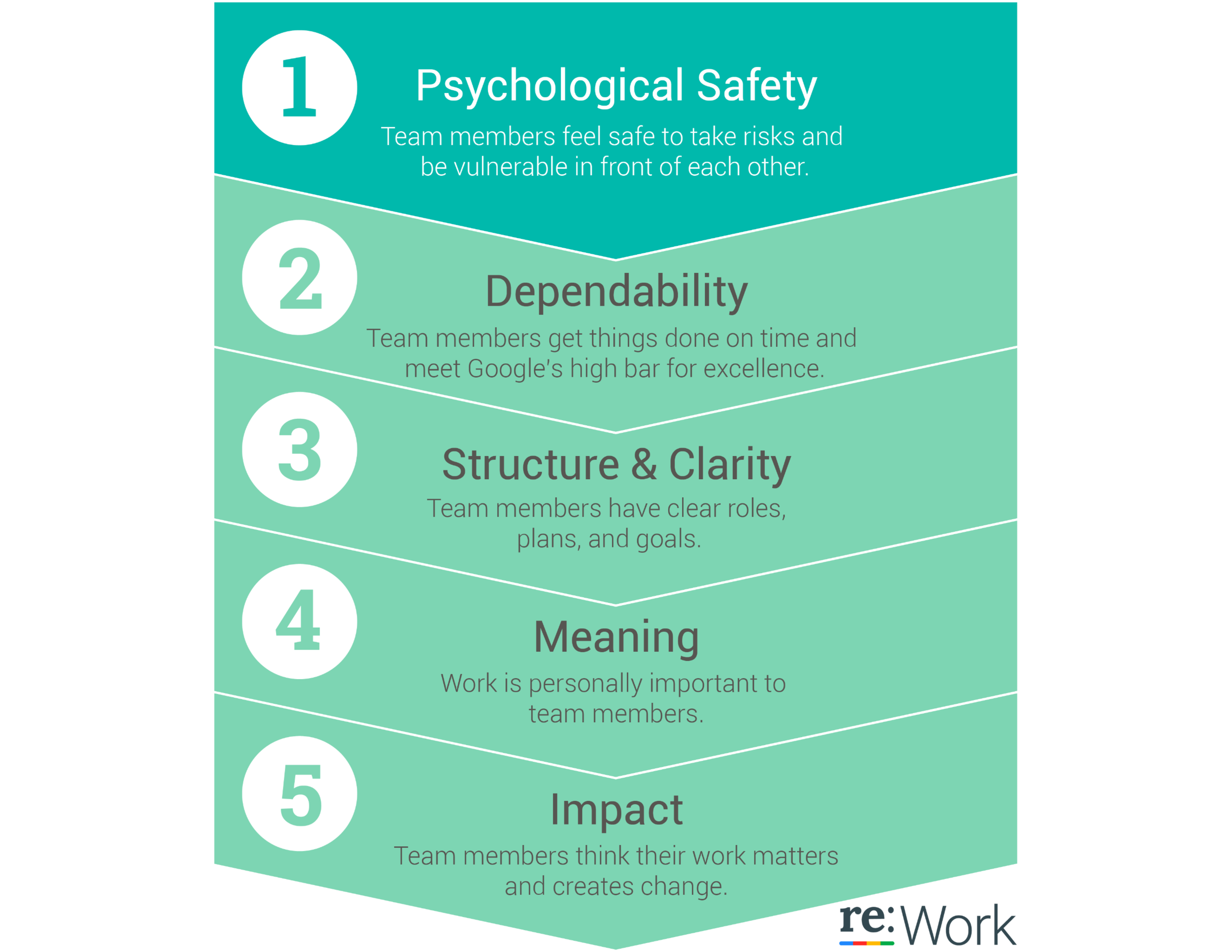
Source: Google
Psychological safety in the workplace can include the ability to freely express ideas and needs without fear of judgment or punishment
Understanding Stress – A Shared Language
Creating psychological safety and addressing work-related stress begins with a shared language around mental and emotional well-being. One of the most powerful places to start is with our nervous system, which plays a central role in how we experience and manage stress.
“The health of our nervous system is perhaps the most important determinant of our mental and physical well-being.
87% of our nervous system activity is below the iceberg and surface of our thoughts.”
Stress responses – whether they are triggered by seeing a lion approach you or by being notified last-minute about an unexpected meeting – activate the sympathetic nervous system, one of two systems of our autonomic nervous system. The sympathetic nervous system is also often called the “fight-or-flight” system, reflecting common responses we experience in the face of stressful or threatening situations. These responses include fighting, fleeing, freezing, or fawning. While not always obvious, these responses can often look like:
• Fight – yelling, reactivity, irritability
• Flee – anxiety, avoidance, worry, overwhelm
• Freeze – depression, disengagement, numbness, shutdown
• Fawn – people-pleasing and overaccommodating
While we sometimes attribute these responses to personality, they are most often natural biological patterns that arise when our fight-or-flight system is activated. These patterns influence how we give feedback, navigate conflict, and make decisions under stress.
According to polyvagal theory, activating our parasympathetic nervous system – the other system of our autonomic nervous system – is an effective way to manage these stress responses and sympathetic nervous system activation (Porges, 2006). The parasympathetic system, also known as the “rest-and-digest” system, supports our body’s digestive and rest processes. Some ways to “turn on” this rest-and-digest system include mindful breathing, gentle or restorative stretches, and listening to calming music or sounds (Gerritsen & Band, 2018; Zaccaro, 2022).
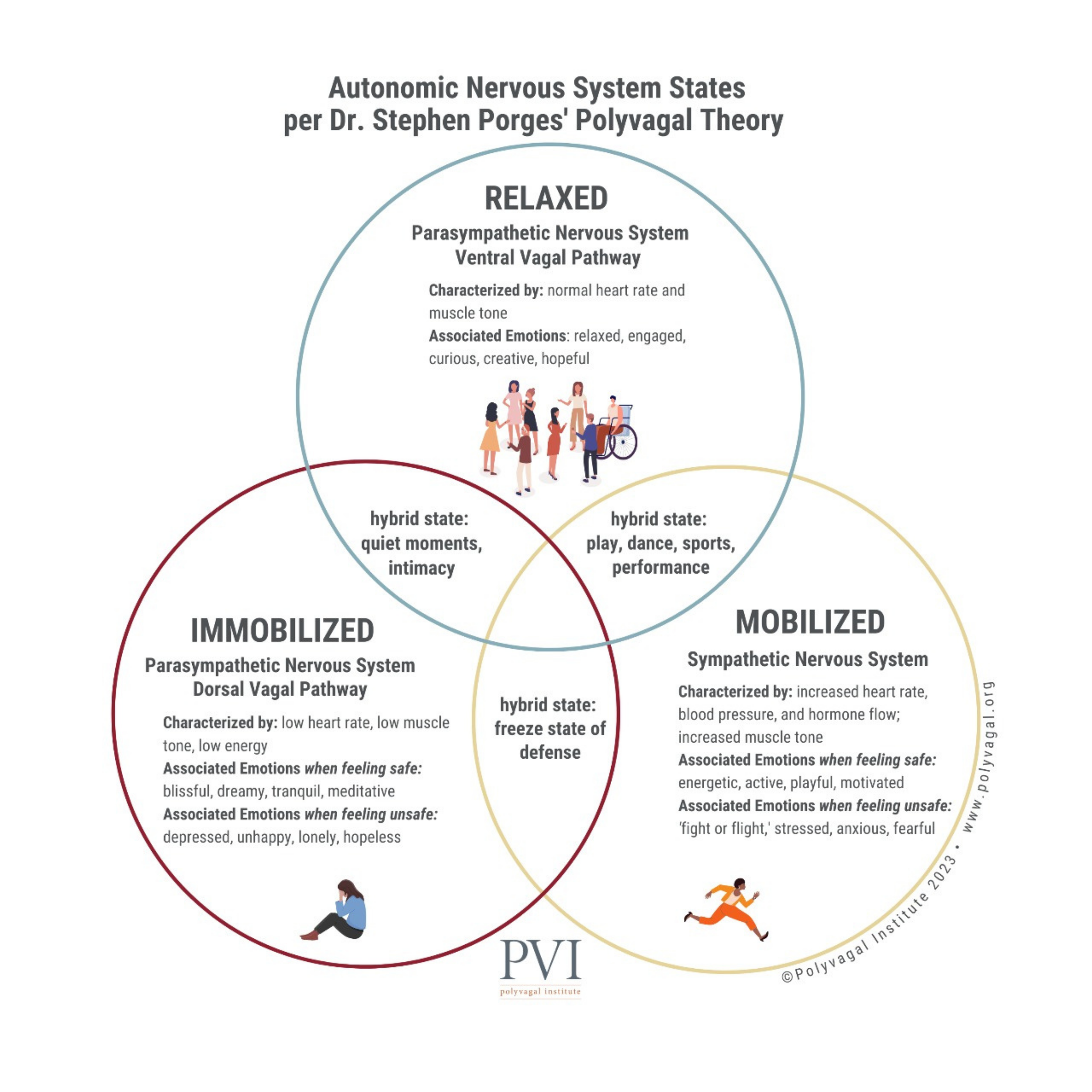
Polyvagal Institute. Polyvagal theory describes the ways in which our autonomic nervous system — comprised of our sympathetic and parasympathetic nervous systems — responds to stressful situations and to intentional strategies for regulating these responses and returning to a state of feeling safe.
2. Why Talking Isn’t Enough: Embodying Safety
Many organizations turn first to conversation when trying to address stress and conflict. Yet it is essential to recognize a deeper truth:
Stress lives in the body.
Neuroscience and polyvagal theory remind us that talking, while valuable, is not enough to regulate stress (Porges, 2006, 2023). True regulation often begins with the body, not just the mind. We need to pay attention to our physical signals before we can process and respond effectively.
Because so much of our nervous system activity happens outside our conscious awareness, working with the body gives us a more direct path to managing stress responses that we may not even realize are present.
Our bodies need to feel safe before our minds can fully engage with logic or language.
Fortunately, interventions to manage stress responses are often simple and include mindful awareness and intentional breathing. Examples of effective tools include:
• Slowing down the breath (especially longer exhales)
• Taking intentional pauses between meetings
• Stepping away from constant stimulation
Research suggests that mindfulness enhances attention, cognitive flexibility, and decision-making—core capacities that support more thoughtful and strategic leadership (Good et al., 2016; Dane & Brummel). In a study by the Institute of Mindful Leadership, 70% of leaders reported that mindfulness improved their strategic thinking.

Photo by Gillian Stargensky
Psychological safety starts with each of us. When individuals and managers feel safe in their bodies, they can share ideas, offer feedback, make mistakes, express emotions, and do their work without fear of punishment or shame.
-
In moments of reactivity, a simple reflection question—“Why Am I Talking?”—can create space between automatic impulse and response, supporting more embodied listening among team members. Tools like the W.A.I.T. question encourage self-awareness and intentional communication, consistent with principles of mindful attention and emotional regulation (Good et al., 2016).
Embodied Listening – W.A.I.T. Tool
Building a culture of safety calls for embodied listening at every level—individual, team, and organization. This means listening with curiosity and a real intention to understand, not just waiting for our turn to speak.

Photo by Diana Mendes
3. Mental Health & Wellness Plan
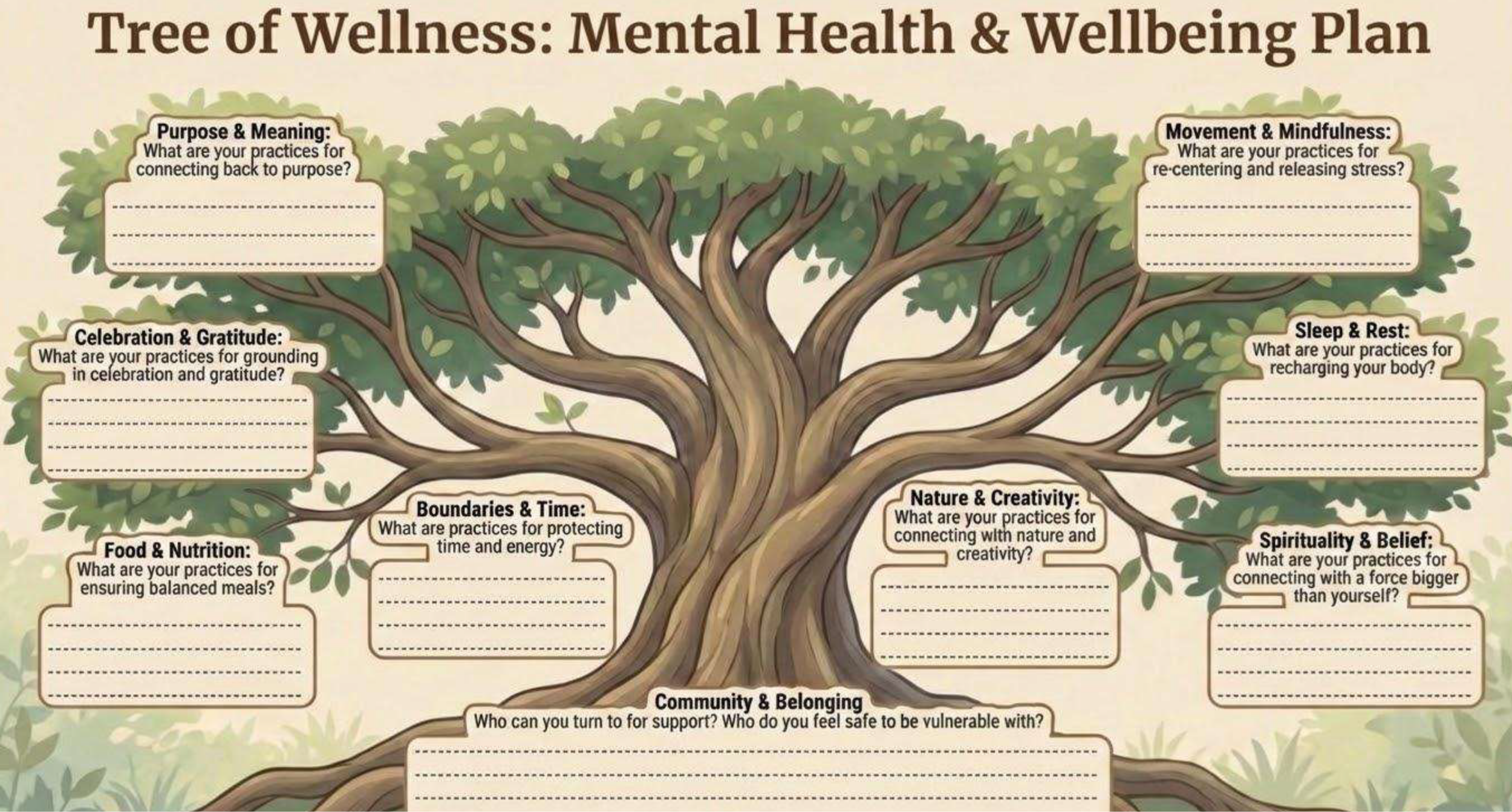
Creating a mental health and wellness plan gives team members a way to identify what supports them and where they want to grow. Checking in on these areas regularly benefits not just individuals, but teams and organizations.
• Movement & Mindfulness – How do you reset your body & mind?
• Purpose & Meaning – What are your practices for connecting back to purpose?
• Food & Nutrition – How do you fuel sustained energy?
• Boundaries & Time – How do you protect focus and capacity?
• Sleep & Rest – How do you recover & recharge?
• Spirituality & Belief – What are your practices for connecting with a force bigger than yourself?
• Celebration & Gratitude – How do you recognize & celebrate progress?
• Nature & Creativity – What are your practices for grounding with nature & creativity?
• Community & Belonging – Who can you turn to for support? Who do you feel safe being vulnerable with?
Advocating for your own mental health, and for the well-being of your team or organization, is essential to showing up fully at work. If making changes in all these areas feels daunting, start small. Focusing on one or two areas at a time can be a powerful and sustainable way forward.
The Tree of Wellness below offers a simple way to notice which practices already support your well-being and which you might want to add. Consider drawing your own version or keeping a copy nearby as a daily reminder.
4. Stress Management Tactics: From Person to Organization
Most of us face stress every day, especially at work. Alongside learning about mental health resources, here are a few practical strategies that individuals, teams, and organizations can begin using right away:
Tactics for Individuals
• Implement an after-work ritual to signal that the day is ending. For example, setting a reminder on your phone to take 3 deep breaths in and out, stretch your arms, and turn on music you enjoy. Once you’re home or away from work, take a moment to do something non-work-related to transition from the workday.
• Display your individual and team Mental Health and Wellbeing Plans or Tree of Wellness in a visible location for daily reference.
• Select one area of your plan to focus on each quarter.
• Practice communicating your needs with colleagues and supervisors.
Tactics for Teams
• Use embodied listening and the W.A.I.T. tool during one-on-one and team meetings.
• Encourage scheduling 45-minute meetings and regular breaks throughout the day.
• Schedule regular check-ins with team members to discuss their well-being and support needs.
• Minimize back-to-back meetings.
• Normalize open discussions about stress and workload capacity.
Tactics for Organizations
• Collaboratively develop shared value and practices for mental health and well-being.
• Promote realistic pacing rather than constant urgency.
• Create an easily accessible list of mental health resources for employees.
• Incorporate compassion into performance expectations.
• Schedule regular organization-wide workshops or meetings on mental health topics, held monthly or quarterly.
• Treat mental health as both an individual and collective responsibility.

Photo by Betzy Arosemena, Unsplash
In Conclusion
If we want teams that are resilient, leaders who are effective, and organizations that perform sustainably, we must stop seeing mental health as only an individual concern.
The path forward is to design collective solutions that support everyone.
The leaders who will define the next era of work are not just strategic thinkers or operational experts. They understand that:
Stress is inevitable, but we can develop the skills to respond to it from a grounded and compassionate place.
Performance is inseparable from well-being. An organization’s culture of psychological safety is directly connected to its impact on the world.
Safety cannot be addressed through discussion alone; it must be embodiedand practiced by individuals, teams, and organizations.
Prioritizing mental health and wellness starts with honest self-awareness and the courage to acknowledge the realities of being human. Learning how our bodies have adapted to our world is essential to our work. When we work with others, we are working with other bodies and experiences. We owe it to ourselves and to each other to lead with care and intention. This is the foundation for a future where our work truly matters.
If you are a leader, team, or organization ready to prioritize this work through workshops, coaching, or developing shared practices in well-being and leadership, please explore our offerings at 👉🏽https://thefairgroundcollective.com/
References & Recommended Reading
American Psychological Association. (2023). Work in America survey: Workplaces as engines of psychological health and well-being. https://www.apa.org/pubs/reports/work-in-america/2023-workplace-health-well-being
Dane, E., & Brummel, B. J. (2014). Examining workplace mindfulness and its relations to job performance and turnover intention. Human Relations, 67(1), 105–128. https://doi.org/10.1177/0018726713487753
Duhigg, C. (2016, February 25). What Google learned from its quest to build the perfect team. The New York Times.https://www.nytimes.com/2016/02/28/magazine/what-google-learned-from-its-quest-to-build-the-perfect-team.html
Gerritsen, R. J. S., & Band, G. P. H. (2018). Breath of life: The respiratory vagal stimulation model of contemplative activity. Frontiers in Human Neuroscience, 12, 397. https://doi.org/10.3389/fnhum.2018.00397
Good, D. J., Lyddy, C. J., Glomb, T. M., Bono, J. E., Brown, K. W., Duffy, M. K., Baer, R. A., Brewer, J. A., & Lazar, S. W. (2016). Contemplating mindfulness at work: An integrative review. Journal of Management, 42(1), 114–142. https://doi.org/10.1177/0149206315617003
Grabbe, L., & Miller-Karas, E. (2018). The Trauma Resiliency Model: A “bottom-up” intervention for trauma psychotherapy. Journal of the American Psychiatric Nurses Association, 24(1), 76–84. https://doi.org/10.1177/1078390317745133
Institute for Mindful Leadership. (n.d.). Research. https://instituteformindfulleadership.org/research/
International Coaching Federation. (2019). Building a coaching culture with managers and leaders.
Maslach, C., & Leiter, M. P. (2016). Understanding the burnout experience: Recent research and its implications for psychiatry. World Psychiatry, 15(2), 103–111. https://doi.org/10.1002/wps.20311
Moss, J. (2019). Burn-out: The secret to unlocking the stress cycle.
Porges, S. W. (2006). The polyvagal perspective. Biological Psychology, 74(2), 116–143. https://doi.org/10.1016/j.biopsycho.2006.06.009
Porges, S. W. (2023). Polyvagal theory: A biobehavioral journey to sociality. Neuroscience & Biobehavioral Reviews.
Wigert, B. (2020, March 13). Employee burnout: The biggest myth. Gallup.https://www.gallup.com/workplace/288539/employee-burnout-biggest-myth.aspx
Zaccaro, A., et al. (2022). How breath-control can change your life: A systematic review on psychophysiological correlates of slow breathing. Scientific Reports, 12, 863. https://doi.org/10.3389/fnhum.2018.00353